

A Tale of Two Campaigns: Parallels Between the Justice for Ryan Passey Movement and Ann Ming’s Historic Fight for Justice


When examining some of Britain’s most determined grassroots justice campaigns, two names emerge repeatedly - Ann Ming, the mother who fought for nearly two decades to overturn the archaic double‑jeopardy law, and the family of Ryan Passey, the young footballer fatally stabbed in a Stourbridge nightclub in 2017. While the tragedies differ, the campaigns borne from them share deep, powerful similarities—rooted in injustice, persistence, and a fierce refusal to let the legal system turn the page without accountability.
Both stories begin not just with loss, but with a shock so profound it ignited long‑term national movements.
A Shared Catalyst: Outrage at a System That Failed Them
In 1989, Ann Ming’s daughter, Julie Hogg, was murdered—yet despite her killer’s later confession, he could not be convicted due to the UK’s ancient double‑jeopardy law. Even after Dunlop admitted the crime while in custody, the law forbade a retrial, leaving the family without justice for years. Ann described the situation as living with her daughter’s murder “all the time,” emphasising how deeply the justice system had failed them.
Similarly, in the case of Ryan Passey, the family’s anguish was intensified by the 2018 acquittal of the man who admitted stabbing Ryan. The verdict was described by the family as a “perverse acquittal” and a form of “double trauma,” leaving them feeling powerless in a system where juries provide no reasoning for serious‑crime verdicts.
In both families’ eyes, justice wasn’t denied by a lack of evidence alone—it was denied by structural failings in the justice process itself.
A Long, Relentless Fight for Accountability
Ann Ming’s fight lasted 15–17 years, during which she lobbied MPs, appealed to the Law Commission, and demanded that outdated legal barriers be removed. That persistence ultimately led to the landmark Criminal Justice Act 2003, which abolished the absolute protection of double jeopardy in cases with compelling new evidence. This historic change allowed Dunlop to finally be convicted in 2006.
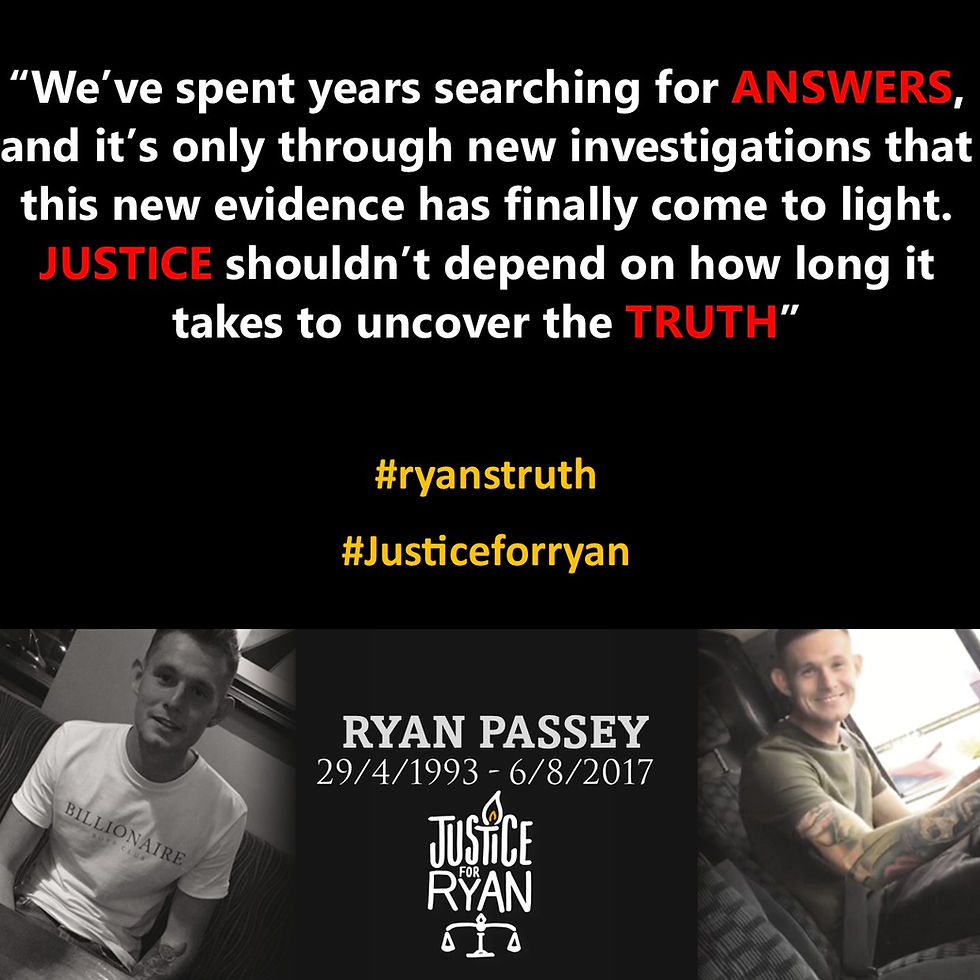
The Justice for Ryan campaign mirrors that same longevity and tenacity. Since 2018, Ryan’s family has maintained a highly visible, unwavering campaign—holding meetings with police, hiring private investigators, and advocating for legal reform around knife crime and jury accountability. Their pressure led to a comprehensive independent review, resulting in 18 recommendations, and the reopening of Ryan’s murder investigation in 2023.
Both campaigns demonstrate that ordinary citizens—armed with persistence—can push institutions into action.
Turning Personal Tragedy into Public Campaigns for Legal Reform
A defining similarity lies in how both families channelled grief into a mission for systemic change.
Ann Ming fought successfully to modernise the law itself, ending an 800‑year‑old legal principle that had protected the guilty under the banner of tradition.
Likewise, the Passey family’s goals extend beyond Ryan’s case. Their campaign calls for reforms to knife crime laws, greater victim rights, and mandated reasoning for jury decisions—changes intended to prevent other families from suffering similar injustice. Their official campaign outlines four pillars—Change, Support, Justice, Legacy—a structure that echoes the expansive ambition seen in Ann Ming’s national reform efforts.
Both campaigns strive to leave a legacy of legal improvements, turning personal loss into nationwide change.
Public Mobilisation and Media Engagement as Driving Forces
Neither campaign remained a private struggle.
Ann Ming’s fight reached newspapers, Parliament, the Law Commission, and even the House of Lords. Her story became emblematic of the need for modernisation in criminal law.
Ryan’s family has similarly harnessed public momentum:
Meeting with the Former PM Boris Johnson, Home Secretary and Justice Ministers.
Annual “Ride for Justice” events attract hundreds of bikers and spectators, symbolising community solidarity.
Their petition has drawn tens of thousands of supporters.
Former MP Suzzane Webb and current MP’s continue to raise the case in Parliament.
Both campaigns demonstrate that sustained visibility—through media, public events, and political support—can keep pressure on institutions that might otherwise allow a case to be forgotten.
Bound by the Emotional Burden of Injustice
Perhaps the most profound similarity is the emotional weight each family carries.
Ann Ming spoke of feeling “very let down” by the justice system, describing the enduring pain of living with unresolved murder.
Ryan’s family expresses the same sentiment—calling their experience a “nightmare,” and likening the acquittal to Ryan being “murdered twice.
The lingering trauma in both cases became the moral engine that kept the campaigns in motion.
Conclusion: Two Families, One Unwavering Message
Though separated by decades, circumstances, and legal contexts, the Justice for Ryan Passey campaign and Ann Ming’s historic fight are linked by a powerful shared truth:
When the justice system fails ordinary people, those same people can rise to challenge it—relentlessly, publicly, and with transformative results.
Ann Ming’s perseverance changed the law for the entire country.
The Passey family’s campaign continues to gather momentum with the same determination and clarity of purpose. Whether their efforts ultimately reshape knife crime legislation or reform jury processes, the parallels with Ann Ming’s battle suggest that such changes are not only possible—they may be inevitable.


Comments